I came across the Kumpo and couldn't stop thinking about it, so I went and read past the viral clips.
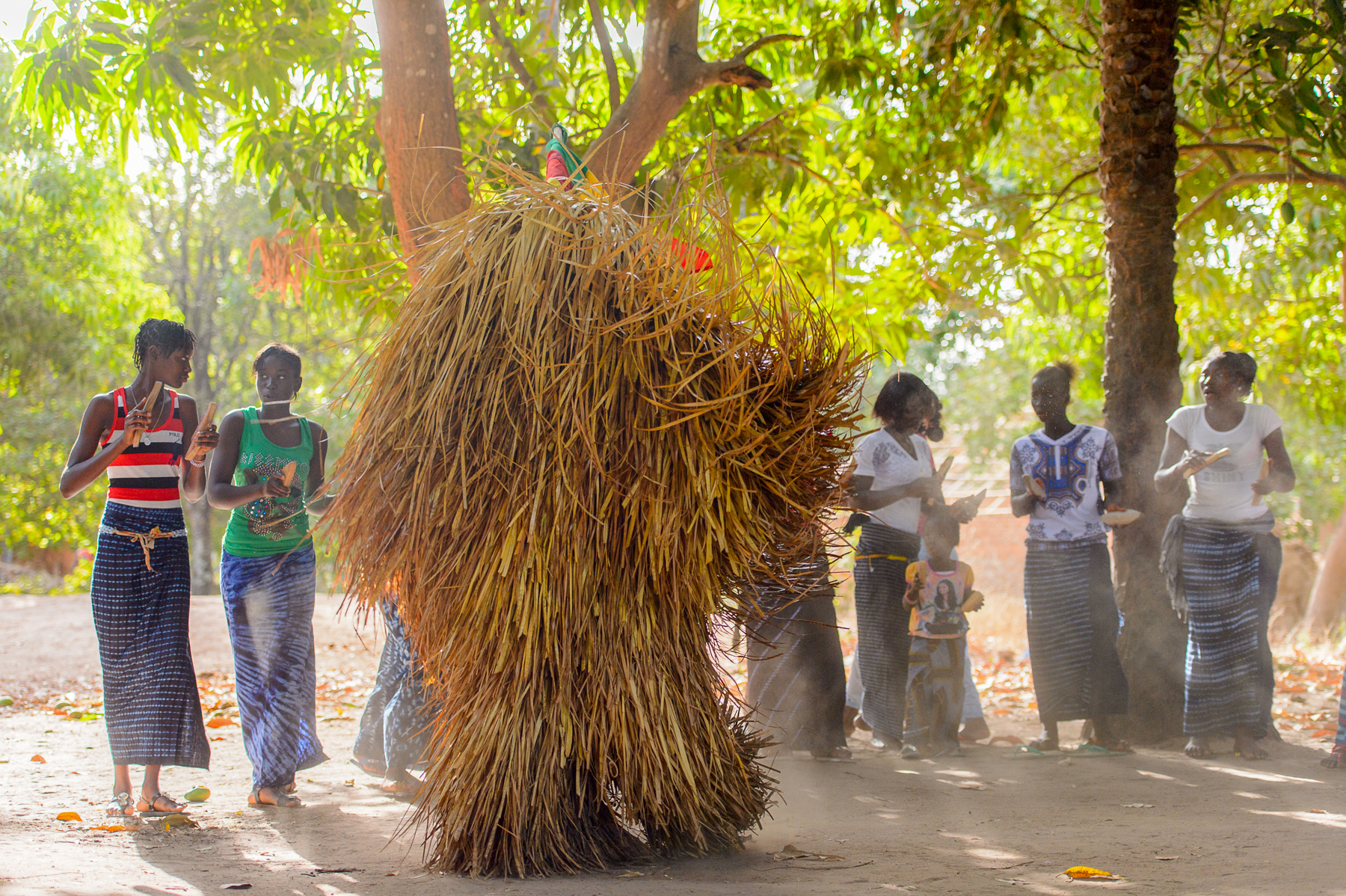
In the Casamance region of southern Senegal, and across parts of Gambia and Guinea-Bissau, the Jola (or Diola) people have a figure called the Kumpo. Westerners describe it as a costume: a body covered head to foot in dried palm and raffia fronds, topped with a single carved rod. But that framing misses the whole point. In the Jola worldview, during the ritual, the Kumpo is not someone wearing something. It is a spirit of the sacred forest, Le Bois Sacré, that arrives.
When it comes, it plants the tip of its rod in the ground and spins, fast, fluid, seeming to move on its own. Women clap two flat wooden stakes together to drive the rhythm. The whole village gathers: elders, young people, children. And there are rules that are not negotiable: you do not look under it, you do not touch it. To try is sacrilege, because it breaks the connection to the spiritual world. The mystery isn't a trick to be exposed; the secrecy is the sacredness.
The Kumpo is one of a trio, alongside the Samay and the Niasse, who appear especially during Bukut, the male initiation rite, to protect the community while its young men are away in the forest. It enforces the village's values: teasing those who shirk work, honoring those who build something shared. And there's a darker signal in it too: if the Kumpo, with certain masks, appears and the mood is wrong, the Diola read it as a warning that something bad is coming.
Why does a student in Paris care about a masquerade in Casamance? Because I think a lot about systems that hold communities together, and most of the ones I build are made of code. The Kumpo is a different kind of system, one that regulates behavior, transmits values across generations, and binds people through awe rather than rules on a page. It's also fragile in a way that feels modern: deforestation is taking the palm leaves it's made from, and young people are leaving for cities like Dakar. A technology of belonging, under pressure from the same forces reshaping everything else.
I find that worth sitting with.